
No matter how many times I visit the lake, there is always the opportunity for seeing something new—some kind of new doorway onto the lake, and maybe also as if I am able to reflect something newly perceived back onto it. Today I’m forced out of the house at an unusual midday hour. The water level has dropped to 1.16m. In the middle of the lake I again see a swan surrounded by coots, and notice this time that the coots are waiting for the leftovers from the grass that the swan pulls up. They circle around the larger bird, waiting patiently, not having to dive. Every now and then the swan lifts is neck out of the water and seems to do some kind of concentrated kicking under the surface, which seems to move sediment into the water around it.
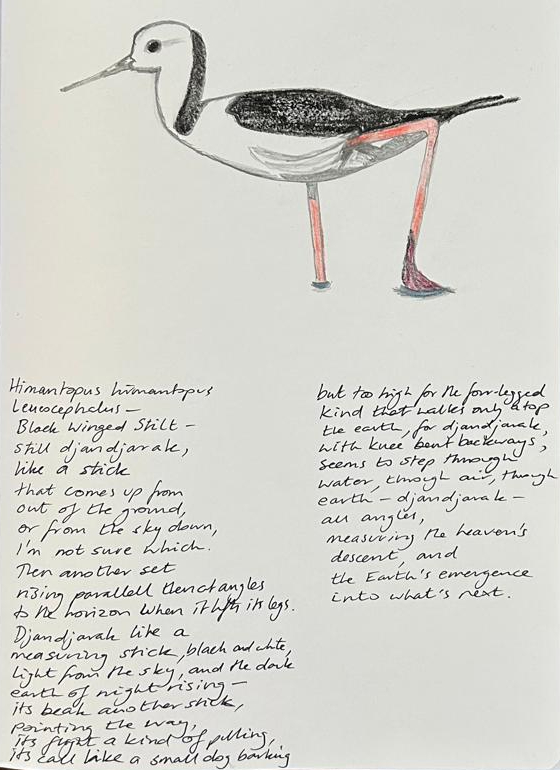
There are also other birds again today, of course. Teals, shovelers, shelducks, black ducks, hardheads, some cormorants, the small raptor, a rail, a moorhen, stilts and more. Near the jetty I watch as a midday black duck flaps and flies briefly then dives for a moment under water, submerged, before it surfaces with water streaming off its back.
And for the first time at this lake I have seen today a bird that I usually only ever see on the coastal shoreline—the white-feathered, orange-beeked, triangular-winged (perfect for bombing beak-first into the water) Caspian tern. He flies one way, then the other, and is gone.
Saturday night evening walk, and we’re out by the cliffs near the river. I look to the west and see the bright light of Venus. I look higher to the east and see an-almost-half Moon that was below Venus at sunset a mere couple of days ago; it points to the Sun. Then to the east I see two satellites heading further east and disappearing, then another heading a different way. Nearby is the bright shining gloss of Jupiter. And above, higher in the sky, in a line between Jupiter and the Moon, is the smaller reddy-blue of Saturn. All of them in a line—Venus, Moon, Saturn, Jupiter—with the three stars of Orion’s belt off to the side.
Back at the lake for the first time in more than a week, and there are birds spread out everywhere. The first thing I notice is the high, melodious sound of the reed warbler; though I can’t see him, I don’t think I’ve ever heard him warble so much. In the centre of the lake a swan is pulling up grass surrounded by coots; the water where they are seems a slightly darker colour, and circular—it seems like it is a real centre today, with a kind of centre of lake gravity, with much movement or birds and water. Elsewhere, there are other coots spread. Shelducks. Pink ears. A hardhead diving down. And then, from across the other side of the lake, very low and rapidly approaching, comes something with a small wingspan, though not flapping but rather gliding and tilting as it goes; it shoots past a little grebe, which ducks under water, by the edge of the reeds in front of us—reeds all top heavy with seed—then tears off to one side and disappears. As it passes by I start to think it is a raptor of some kind, maybe a kestrel or hobby. No other bird seems to feel threatened, or maybe even notices. It was such a brief, sharp flash.
Somehow finding ourselves in Saturday morning traffic on the upriver bridge crossing in Fremantle. We’re heading south and the trucks are banked up in the left lane. I’m in the passenger seat for the first time in a long time, and I’m looking at directions on my phone. I take a moment, however, to pull myself away in order to look down at the river. The car has stopped, the traffic is so slow. And there, by the edge of the jetty in front of the Left Bank Hotel, is one small dolphin coming up for air. Then a moment later, another kwilena even closer to the shore. I watch and watch but see no more movement in the water. I look around to see if anybody else has noticed anything. There is a guy fishing nearby, who must have seen; and people on the walkway have stopped near the jetty to look at something. The car starts to move.
The things I must miss while driving.
December, and usually blue skies and predictable winds on Whadjuk country. But today there is cold wind and nimbus and rain. And I can’t help noticing that it is also new moon today—with rain, again.
Wardandi country with nephew Fin and a similar thing is happening to around this time last year. When he first arrived in Australia and we went to Dwellingup, he would say things like, ”Have you ever seen a goanna?” and there would be one. “What about an emu?” and soon after one would appear. Then we went to Dunsborough. “Snakes?” and then we’d see one. “You’d better be careful what you ask next,” I said. The following day, while walking next to the shallows of Geographe Bay, he asked if I’d ever seen a shark up close. We then saw a shovelnose where I’d never seen one before; it was headed one way, so we doubled back and decided to have a quick swim. Fin decided to go further out. He’s adamant the shark brushed his leg.
That was all last year. This time when we go to Wardandi Country he doesn’t say anything. But when we sit and have lunch at Yallingup, a yoornt bobtail/blutongue lizard emerges from out the bushes, across a long stretch of grass and comes right to our feet; I have to erect a kind of wall of thongs and towel to keep him at bay. The seagulls were a little bit more predictable. That evening at Castle Rock carpark quenda the bandicoot appears from near the barbecues and comes within a couple of arm lengths. Shortly after, karda the goanna lazily turns around by the edge of the Meelup trail to look at us, but doesn’t bother to move as we go by. When we put our rafts in the water we see a large baamba stingray moving in the shallows. We ride the wind all the way towards Meelup Beach, pausing at times along the way to lie back and look out north across all the water of the bay. Coming into Meelup we pass through a couple of large white rocks of roosting cormorants—appearing like a kind of gauntlet—with only one or two birds on nearby smaller rocks flying away as we pass. The next day, walking along the same trail, a young yonga kangaroo lifts its head and observes us no more than four metres away. We pause and wait for it to hop off, but he stays put, only moving his ears slightly. And, finally, that evening, goomal the possum arrives on the verandah. We open the door to observe him, and he begins to approach, pink nose in the air.
 John Stubley