There are signs with bird names, pictures and descriptions
at the lake.
Somebody wrote on one of them a year or so ago
in black pen “Nyungar names?”
A few days later the question was scrubbed off again;
gone, like it had never been.
Sometimes I run into the signs’ creator and her husband.
Last weekend Katie suggested we write up the names
on stickers and place them on.
This week we’ve been talking about where we
get our stories from—Katie kept mentioning signs like these.
Today, also in black pen,
someone has begun writing names under some of the birds.
Kakak. Yet. Kidjibroon. Kanamit. Wimbin. Maali. Wayan.
That’s as far as they’ve got.
I know the book they’re taken from—
they’re the same as the names I’ve learned.
Three days later the names are still there.
I wonder what the response will be
this time.
Category Archives: Nature Poetry
The Lake’s Contraction
Lake today, well into Birak, levels at 1.13 metres, or thereabouts. There are birds scattered across the water—mostly coots in the centre—with ducks of all kinds on the edges, as well as a few swans, stilts, and more. There is relative calm as I watch from under the figs on the south end in the shade. And then, suddenly, there is a simultaneous flutter and flurrying of wings as birds from the north and from all edges of the lake fly towards its centre. They seem to fly together in species clouds—there is a group of stilts, and a group of teals, there are Pacific black ducks together (with nine newborn chicks in a line trailing after), and amongst the groups are scattered also coots, shelducks, shovelers, wood ducks, pink ears low and grey, probably some hardheads but I don’t see them, some grey-feathered cygnets. Even the white corellas above me start fussing about, though only slightly moreso than usual. I’m looking around for the raptor—likely the swamp harrier—and there he is, coming in low across the grass and rushes like a jumbo coming into land, then flying higher, whirling around. More birds fly into the centre, other birds come in from the north. Crows fly across the lake, but don’t head towards him. There are no seagulls to chase him today. Up above, much higher, a cormorant is exiting the scene, while about the same level as the harrier a white-faced heron is honking and gripping at the air the way he does in his flying style. More birds come towards the southern part of the lake—it is getting pretty full in there. Only the ibis seem to have stayed put on their melaleuca perches to the west. The harrier cruises around for a while longer, mostly over the rushes to the east, before eventually returning to the north, as the birds begin to slowly move back towards the edges from the deepest part of the lake—the last part to dry in late summer. The whole scene like the workings of a kind of organism—the way a body can contract towards the centre in the face of fear.
Full Sky
We start a fire and then I’m hit with the sudden thought reminder that it is full moon tonight. We head out towards the river through the narrow laneway, and as the path opens up suddenly there it is, big and bold and yellow between clouds on the horizon, its reflection lighting up a rippled line along the river. Above, between the clouds right at this moment is Jupiter, then Saturn higher, and then a very bright Venus to the west. The belt of Orion still off to the right.
Calling the ‘Wild’
Our friend from the Netherlands is staying with us, and we go for an evening walk along the cliffs by the river. I make a quick scan for dolphins. “Dolphins!” he says.”Where?” my wife replies. “Calling to them,” he adds. “Dolphins!” We walk on, maybe no more than a hundred metres, and then I spot some by the cliffs on the north side, heading downriver—one, two, three dolphins. We watch them come towards us, cutting across the edge of the sandbar, before they go past, heading further south. We go on to the end of our usual walk, pausing a little longer at the turnaround than we usually do; and in that time we see another pod on the other side of the river by the tree where all the night herons roost—one, two swishing around in the flatwater shallows between the yacht club jetties. “If I had the honour of naming dolphins, I’d call them Pea One, Pea Two and Pea Three,” our friend says. “Peas in a pod.”
We turn back towards home, and within a couple of hundred metres, there are some more dolphins right in the armpit of the river—right where it bends. We can see their tails—they look to be fishing—maybe one, two, even three. “Could be the same ones. But usually if they’re heading downriver they won’t turn around and come back again.” So we’ve either seen three groups in one outing (highly unusual), or two with one group behaving very unusually—whether they’re all part of the same overall pod (they’re not usually that spread out) or different ones.
We thank the kwilena the dolphin…and our friend.
Full Moon Summer Rain
Today preceded by alto clouds like snakeskins, predicting rain. In the morning my wife and I head out, grey skies to the west. “It said it was going to rain today,” she says. We look at her weather app. The image says rain. The words say no rain. The clouds look dark. We walk on, and before we get to where we’re going there is the very lightest misty spray, and then it is over. “Unusual for this time of year,” she says. Only later that night do I remember the full moon.
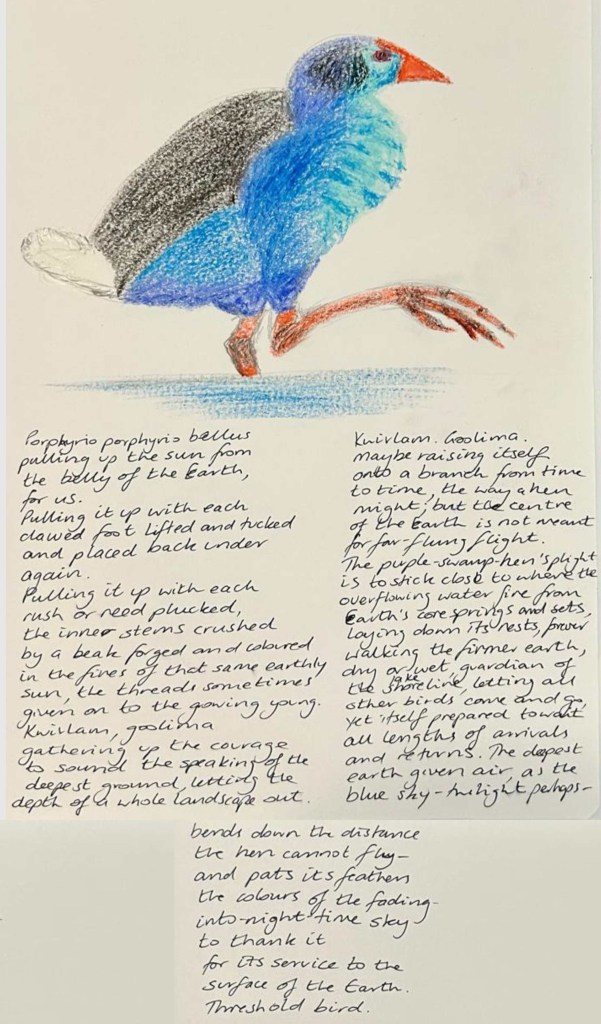
Reflecting the Lake
No matter how many times I visit the lake, there is always the opportunity for seeing something new—some kind of new doorway onto the lake, and maybe also as if I am able to reflect something newly perceived back onto it. Today I’m forced out of the house at an unusual midday hour. The water level has dropped to 1.16m. In the middle of the lake I again see a swan surrounded by coots, and notice this time that the coots are waiting for the leftovers from the grass that the swan pulls up. They circle around the larger bird, waiting patiently, not having to dive. Every now and then the swan lifts is neck out of the water and seems to do some kind of concentrated kicking under the surface, which seems to move sediment into the water around it.
There are also other birds again today, of course. Teals, shovelers, shelducks, black ducks, hardheads, some cormorants, the small raptor, a rail, a moorhen, stilts and more. Near the jetty I watch as a midday black duck flaps and flies briefly then dives for a moment under water, submerged, before it surfaces with water streaming off its back.
And for the first time at this lake I have seen today a bird that I usually only ever see on the coastal shoreline—the white-feathered, orange-beeked, triangular-winged (perfect for bombing beak-first into the water) Caspian tern. He flies one way, then the other, and is gone.
Stars in a Line
Saturday night evening walk, and we’re out by the cliffs near the river. I look to the west and see the bright light of Venus. I look higher to the east and see an-almost-half Moon that was below Venus at sunset a mere couple of days ago; it points to the Sun. Then to the east I see two satellites heading further east and disappearing, then another heading a different way. Nearby is the bright shining gloss of Jupiter. And above, higher in the sky, in a line between Jupiter and the Moon, is the smaller reddy-blue of Saturn. All of them in a line—Venus, Moon, Saturn, Jupiter—with the three stars of Orion’s belt off to the side.
Gravity and Raptors
Back at the lake for the first time in more than a week, and there are birds spread out everywhere. The first thing I notice is the high, melodious sound of the reed warbler; though I can’t see him, I don’t think I’ve ever heard him warble so much. In the centre of the lake a swan is pulling up grass surrounded by coots; the water where they are seems a slightly darker colour, and circular—it seems like it is a real centre today, with a kind of centre of lake gravity, with much movement or birds and water. Elsewhere, there are other coots spread. Shelducks. Pink ears. A hardhead diving down. And then, from across the other side of the lake, very low and rapidly approaching, comes something with a small wingspan, though not flapping but rather gliding and tilting as it goes; it shoots past a little grebe, which ducks under water, by the edge of the reeds in front of us—reeds all top heavy with seed—then tears off to one side and disappears. As it passes by I start to think it is a raptor of some kind, maybe a kestrel or hobby. No other bird seems to feel threatened, or maybe even notices. It was such a brief, sharp flash.
Dolphins In Traffic
Somehow finding ourselves in Saturday morning traffic on the upriver bridge crossing in Fremantle. We’re heading south and the trucks are banked up in the left lane. I’m in the passenger seat for the first time in a long time, and I’m looking at directions on my phone. I take a moment, however, to pull myself away in order to look down at the river. The car has stopped, the traffic is so slow. And there, by the edge of the jetty in front of the Left Bank Hotel, is one small dolphin coming up for air. Then a moment later, another kwilena even closer to the shore. I watch and watch but see no more movement in the water. I look around to see if anybody else has noticed anything. There is a guy fishing nearby, who must have seen; and people on the walkway have stopped near the jetty to look at something. The car starts to move.
The things I must miss while driving.
 John Stubley